A practical AI product does not begin with a model catalogue. It begins with a piece of work: who performs it, what information they use, where the process slows down, and what a better outcome would look like.
That distinction matters because a technically impressive prototype can still fail as a product. If it does not fit the workflow, respect permissions, handle exceptions, and improve a measurable result, the model is only a demonstration.
The useful sequence is workflow, friction, information, solution choice, narrow capability, human oversight, evaluation, integration, and continuous improvement. Sometimes that sequence leads to generative AI. Sometimes it leads to rules, an integration, conventional machine learning, or no new software at all.
Key takeaways
- Start with the workflow, not the model.
- Identify a narrow decision or bottleneck where AI can add measurable value.
- Keep deterministic rules for work that does not need AI.
- Design data quality, human oversight, and evaluation from the beginning.
- A practical AI product must fit the existing business system, not just work in a demo.
Start with the workflow, not the AI model
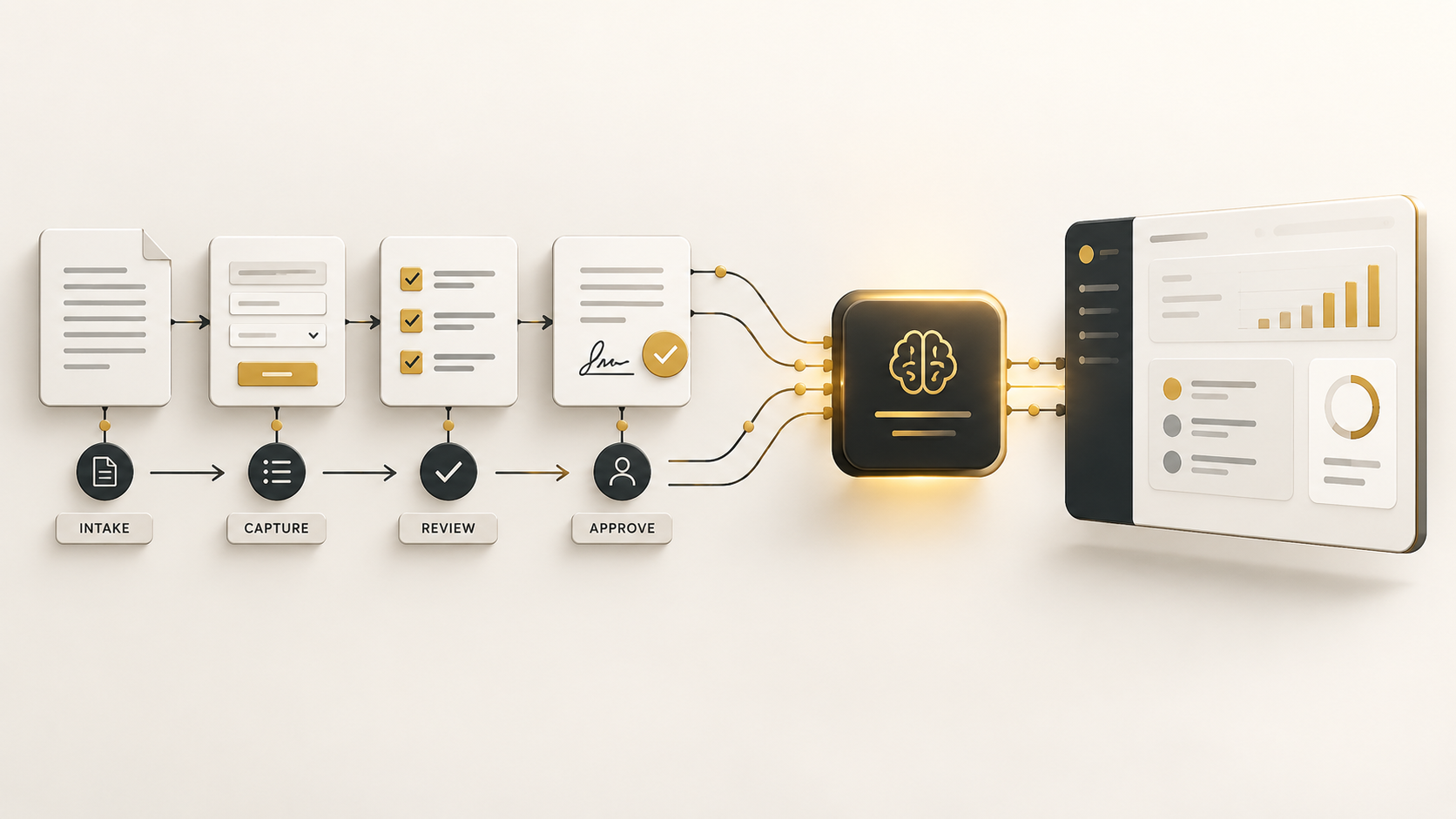
Map the work as it happens today. Identify the actors, inputs, decisions, systems, handoffs, outputs, delays, and repeated manual steps. Include the informal workarounds that people use when the official process does not cover a real case.
A workflow map should make the movement of information visible. Where does a request enter? Who decides what happens next? Which system holds the authoritative record? What must be copied between tools? Which delay is caused by missing information, and which is caused by a genuinely difficult judgment?
This creates a business baseline. Without it, a team may automate the easiest-looking step while leaving the true bottleneck untouched. With it, the team can define a target such as reducing avoidable rework, shortening a review queue, improving classification consistency, or making internal knowledge easier to retrieve.
Find the actual problem inside the workflow
The strongest opportunities are usually narrower than “use AI in this department.” They are specific points where people spend time interpreting information, predicting an outcome, finding relevant knowledge, or preparing a response.
Illustrative examples include categorising incoming requests, extracting fields from documents, helping employees retrieve approved internal knowledge, forecasting demand, prioritising cases, or drafting responses for human review. These examples are not recommendations by themselves; each still needs evidence that the problem is frequent, valuable, and suitable for automation.
Describe the problem without naming a technology: “An operator spends twelve minutes finding the right policy and still needs a second review” is more useful than “We need a chatbot.” The first statement can be observed and tested. The second has already jumped to a solution.
Decide whether the problem actually needs AI
Different problem shapes call for different starting approaches. The categories below can overlap, but they help prevent unnecessary complexity.
Problem type | Usually best starting approach | Why |
|---|---|---|
Fixed business rules | Deterministic software | Explicit rules are predictable, testable, and easier to audit. |
Repeated system-to-system task | Automation or integration | The work may only require moving validated data and triggering known actions. |
Prediction from historical patterns | Machine learning | A predictive model may identify patterns that fixed rules cannot express reliably. |
Understanding or generating unstructured content | Generative AI | Language or multimodal models can work with text, images, and other unstructured inputs. |
Multi-step tool-using workflow | Agentic approach where justified | An agent may coordinate steps and tools, but it adds autonomy, failure modes, and oversight needs. |
Start with the least complex approach that can meet the requirement. Rules can sit beside a model. Automation can validate inputs before an AI step. A person can approve an action after a model proposes it. Architecture is a composition, not a contest between labels.
The NIST AI Risk Management Framework explicitly includes viable non-AI alternatives in risk management and asks organisations to define business context, intended tasks, benefits, costs, and human oversight. That is a useful discipline before committing to AI.
Define one narrow AI capability
An initial product should solve one valuable step well. “Extract these six fields from this document and flag uncertain values for review” is a buildable capability. “AI-enable operations” is not.
A narrow scope makes evaluation possible. It limits the number of inputs, outputs, policies, and failure modes the team must understand. It also creates a clean boundary: what the product will do, what it will refuse to do, and what remains a human responsibility.
Understand the information the product will need
AI quality cannot be separated from information quality. Before building, determine what data exists, who owns it, whether it is current, and whether the intended users and systems are permitted to access it.
Availability: the required information exists in a usable form.
Quality: records are sufficiently accurate, complete, and representative for the task.
Permissions: access follows privacy, confidentiality, and role requirements.
Freshness: the product can distinguish current guidance from obsolete material.
Ownership: someone is accountable for corrections, retention, and source-of-truth decisions.
Structure: the design accounts for both structured records and unstructured documents or messages.
If the product retrieves internal information, it also needs rules for source selection, citations, access control, and what happens when no reliable source is found. If data cannot be used lawfully or safely, the product requirement must change.
Design the human role
Human oversight is not a button added at the end. Define which outputs require approval, which cases must be escalated, how exceptions are handled, and what evidence an operator needs to understand or challenge a result.
Confidence signals can help in some systems, but they should not be treated as universal truth meters. The useful question is operational: what conditions make the result safe to use automatically, safe only after review, or unsafe to use at all?
NIST's AI RMF asks teams to document knowledge limits, intended human use, oversight processes, and evaluation considerations. Its Generative AI Profile extends that risk-management approach to generative systems, including governance, measurement, incident handling, and ongoing monitoring.
Choose the right architecture
A practical AI product usually has several layers. The business application presents the workflow. Orchestration and business logic enforce rules and sequence actions. A model or tool layer performs the specialised capability. Data and retrieval supply permitted context. Monitoring records performance, failures, and operational signals.
Keeping these responsibilities distinct makes change safer. A model can be replaced without rebuilding the whole product. A business rule can stop an unsafe action even when a model suggests it. Retrieval can be limited by user permissions. Observability can show whether errors originate in source data, orchestration, the model, or an external system.
This is also where conventional product engineering matters. Authentication, audit trails, data validation, retries, failure states, and maintainable interfaces may contribute more to reliability than a marginal improvement in model capability. RISPU's AI Products & Automation service treats the model as one part of the working system.
Build evaluation before scaling
Create a representative test set before the prototype becomes difficult to challenge. Include normal cases, ambiguous inputs, missing information, policy-sensitive cases, and examples that should be escalated or refused.
Evaluation should match the task. Measures may include task success, correctness, groundedness when answers depend on supplied sources, failure categories, latency, operating cost, human correction rate, and the intended business outcome. There is no universal passing score; the acceptable threshold depends on impact, risk, and the available fallback.
Record failures by category rather than hiding them inside one average. A product that performs well overall but fails consistently on a high-impact exception is not ready for that exception. Evaluation should continue after launch because data, workflows, integrations, and model behaviour can change.
Integrate the AI into the existing workflow
Value often depends more on integration than model novelty. The product must receive the right input at the right moment, return a useful result in the tool people already use, and preserve the context required for review or follow-up.
Avoid creating a separate AI destination that forces staff to copy information out of one system and manually reconstruct it in another. Good integration reduces handoffs, maintains permissions, writes approved results back to the source of truth, and makes failure visible.
Where the workflow also needs new interfaces, databases, or operational tools, the AI capability may sit inside a broader website, web application, or custom software build rather than operate as a standalone feature.
Prototype narrowly, then expand
A disciplined sequence keeps technical work connected to evidence:
Map the existing workflow and baseline the problem.
Choose one valuable, bounded use case.
Build a representative test set, including failures and exceptions.
Prototype the narrow capability.
Evaluate task quality and operational impact.
Add safeguards, escalation, permissions, and auditability.
Integrate the capability into the real workflow.
Monitor quality, cost, latency, corrections, and incidents.
Expand only when evidence justifies the next capability.
Common mistakes
Choosing a model before defining the workflow problem.
Using AI where clear deterministic rules would be more reliable.
Ignoring data access, ownership, permissions, or freshness.
Launching without a representative evaluation set.
Providing no human fallback for uncertain or exceptional cases.
Designing a demo-first architecture that omits security, integration, and operations.
Automating an already broken workflow instead of repairing it first.
Trying to replace an entire role rather than improve a specific task.
A practical AI-product checklist
The workflow and user are clearly defined.
The problem occurs often enough and matters enough to solve.
Non-AI alternatives have been considered.
The initial capability has a narrow boundary and measurable outcome.
Required data is available, permitted, current, and owned.
Human approval, escalation, and fallback paths are defined.
A representative evaluation set exists before release.
The design includes integration, security, auditability, and monitoring.
Expansion depends on evidence, not novelty.
Final perspective
The strongest AI products make useful work easier, faster, or more reliable. They begin with a real workflow, make a bounded promise, and prove that promise under realistic conditions.
The model itself is not the product. The product is the complete system around it: the user experience, rules, data, safeguards, integration, measurement, and operating process that turn a capability into dependable work.
If you have a workflow worth examining, send RISPU a project brief with the current process, friction, and desired outcome rather than a predetermined model choice.