
Key takeaways
- SEO, GEO, and AI visibility overlap, but they describe different parts of digital discovery.
- SEO remains the technical and content foundation for traditional search and many AI-powered search experiences.
- GEO focuses on making information clear, useful, retrievable, and suitable for grounding generative answers.
- AI visibility is the broader outcome: whether AI-powered systems can discover, understand, retrieve, cite, or surface a business or its content.
- No legitimate optimization strategy can guarantee a citation, AI Overview appearance, or recommendation from a specific AI system.
SEO, GEO and AI visibility are related — but they are not the same
Search is changing quickly.
A person looking for information may still type a query into a traditional search engine, but they may also ask a conversational question in an AI-powered search experience, use an AI assistant to compare options, or receive an AI-generated summary before deciding which website to visit.
This has introduced a growing set of terms: SEO, GEO, AEO, AI search optimization, and AI visibility.
The terminology can make the situation sound more complicated than it needs to be.
The practical reality is simpler:
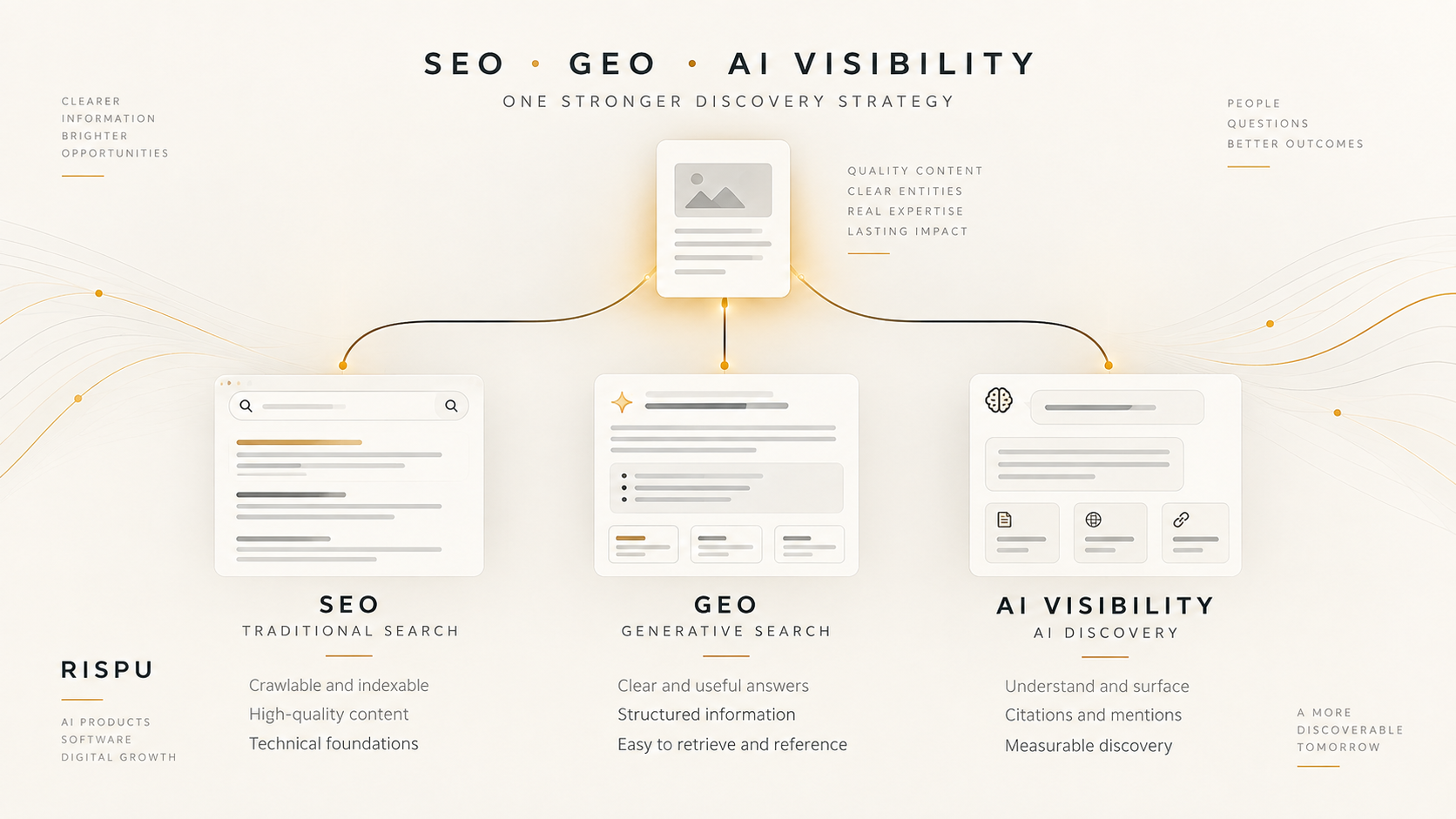
SEO helps search systems discover, understand and rank web content.
GEO focuses on making information useful and retrievable within generative search and answer experiences.
AI visibility describes the broader result — whether AI-powered systems can correctly understand, retrieve, reference or surface your business and information.
These are not three completely separate marketing disciplines.
They are overlapping layers of the same discovery problem.
Google's current guidance makes this especially clear: the company says existing SEO best practices remain relevant for AI Overviews and AI Mode, and there are no special technical requirements that replace normal search fundamentals.
SEO vs GEO vs AI visibility
Area | Main question | Typical focus |
|---|---|---|
SEO | Can search engines discover, understand and rank this page? | Crawling, indexing, content quality, internal links, technical SEO, authority |
GEO | Can generative systems retrieve and use this information effectively? | Clear answers, entity context, evidence, structure, freshness, source usefulness |
AI Visibility | Is the business or content actually appearing across AI-powered discovery experiences? | Mentions, citations, retrieved pages, grounding queries, entity understanding |
The important distinction is that SEO and GEO are practices, while AI visibility is better understood as an observable outcome.
You can work on the first two.
You can measure aspects of the third.
But you cannot force an AI system to cite or recommend a particular website.
What SEO means in 2026
SEO has not disappeared because generative AI became popular.
If anything, strong search foundations have become more important.
For Google's AI features, a page must still be eligible for Google Search and capable of being indexed and shown with a snippet. Google explicitly states that there are no additional technical requirements solely for appearing in AI Overviews or AI Mode.
That means businesses should still pay close attention to fundamentals such as:
crawlability
indexability
descriptive page titles
useful headings
clear internal linking
canonical URLs
structured data that matches visible content
fast and usable pages
high-quality original content
accurate business information
useful images and video where appropriate
SEO is therefore still the infrastructure layer of digital discovery.
If a search engine cannot reliably crawl or interpret your website, expecting strong visibility in AI-powered search is unrealistic.
What GEO actually means
Generative Engine Optimization, or GEO, is an industry term rather than a universal technical standard.
A useful way to think about GEO is:
improving how clearly your information can be understood, retrieved, evaluated and reused within generative search experiences.
That does not mean adding a special “AI schema” or creating hundreds of artificial question-and-answer pages.
Google specifically says website owners do not need special AI text files or new schema markup to appear in its generative search features. It also warns against mass-producing pages for every possible query variation simply to manipulate AI or search results.
Good GEO tends to look much less exotic.
It often means improving things that are already valuable to users:
answer important questions directly
clearly identify the entities, products, services and locations being discussed
use descriptive headings
support important claims with evidence
provide original examples or first-hand knowledge
keep facts current
create logical internal relationships between pages
avoid ambiguity
make primary information available as readable text
In other words, GEO should generally make a website more useful and understandable, not more artificial.
What AI visibility means
AI visibility is broader than simply “ranking in ChatGPT.”
Different AI systems use different retrieval methods, search indexes, models, partners and citation systems.
A business may appear in one AI experience but not another.
A page may be retrieved without receiving a visible citation.
A company may be mentioned from existing model knowledge rather than live web retrieval.
That means AI visibility needs to be measured carefully.
For RISPU, a useful definition is:
AI visibility is the degree to which AI-powered discovery systems can correctly identify, retrieve, understand and surface a business, product, service or piece of content.
That can include several signals:
whether a brand is mentioned
whether its website is retrieved
whether its pages are cited
which pages are used as sources
which topics or queries trigger retrieval
how consistently the brand is described
whether first-party content contains sufficient evidence to answer relevant questions
Microsoft has already started turning some of these ideas into measurable data. Bing Webmaster Tools' AI Performance report shows citation activity, cited pages and grounding queries across supported Microsoft AI experiences. Microsoft also explicitly notes that these metrics do not represent rankings, authority or page importance.
What has actually changed in search
The biggest change is not that websites have stopped mattering.
The change is that the interface between the user and the web is becoming more mediated.
Previously, the typical path looked like:
query → search results → website
Increasingly, some journeys look like:
question → generated answer → cited sources → website
or even:
question → generated comparison → follow-up question → selected source
This changes the value of content.
A page now needs to do more than target a phrase.
It needs to contain information that can be confidently interpreted and retrieved in context.
Google describes its generative search systems as using techniques including retrieval-augmented generation, where relevant and current web pages are retrieved from its Search index to help ground responses.
This makes information quality, clarity and context increasingly important.
What has not changed
Several fundamentals remain remarkably stable.
Useful content still matters
Content created primarily to manipulate a system is fragile.
Content that genuinely helps somebody understand, compare, decide or solve something remains useful regardless of whether the interface is ten blue links or an AI-generated response.
Crawlability still matters
AI search does not magically remove the need for machines to access information.
For ChatGPT search specifically, OpenAI recommends allowing OAI-SearchBot if a publisher wants public content to be discoverable for search experiences. OpenAI also makes clear that allowing access does not guarantee placement.
Authority still has to be earned
Adding the words “expert,” “best,” or “trusted” to a page does not create authority.
Strong authority signals come from useful work, credible references, consistent information, real expertise, original evidence and a reputation built over time.
Technical quality still matters
Broken canonicals, inaccessible pages, duplicate content, missing internal links and poor site architecture do not become irrelevant because an AI system sits above the search layer.
What businesses should prioritize
The practical strategy is not:
SEO or GEO?
It is:
build one strong information foundation that works across search and AI discovery.
1. Make your website technically discoverable
Start with:
crawlable pages
indexable content
clean canonical URLs
XML sitemap
useful internal links
descriptive metadata
correct HTTP responses
mobile usability
structured data where appropriate
These are still foundational.
2. Make your business easy to understand
A website should make basic questions easy to answer:
Who are you?
What do you provide?
Who is it for?
Where do you operate?
How are your services related?
What makes each product or service distinct?
Ambiguous websites are difficult for both people and machines.
3. Publish information worth retrieving
Avoid producing articles simply because a keyword tool showed search volume.
Create content containing something useful:
experience
original analysis
practical explanations
examples
comparisons
data
methodology
clearly sourced facts
first-party knowledge
Google's 2026 generative AI guidance specifically emphasizes valuable, unique and non-commodity content.
4. Connect your content
An isolated blog post has less context than a well-connected information system.
An article about AI automation should naturally connect to:
the relevant service
related technical guides
examples or products
supporting research
the company or product entity behind the content
Internal linking helps both users and crawlers understand those relationships.
5. Keep important information current
Outdated pricing, addresses, product descriptions or technical recommendations can reduce trust.
For engines supporting it, tools such as IndexNow can help notify participating search systems when pages are created, materially updated or removed.
The notification does not guarantee indexing, but it can speed up discovery of changes.
6. Measure instead of guessing
AI visibility should not be treated as a mystical score.
Use observable evidence where possible.
That can include:
Google Search Console
Bing Webmaster Tools
Bing AI Performance
indexed pages
citation activity
grounding queries
pages retrieved
relevant referral traffic
controlled visibility monitoring
Google has also introduced dedicated Search Generative AI performance reporting in Search Console, with worldwide rollout completed in August 2026, giving site owners another way to examine visibility in generative Search experiences.
A practical 2026 framework
That is a more durable strategy than chasing every new acronym.
Common mistakes businesses should avoid
Treating GEO as a replacement for SEO
This creates the wrong starting point.
Generative discovery still depends heavily on the same information ecosystem created by search engines, publishers and websites.
Publishing hundreds of low-value AI articles
Volume is not authority.
Publishing large numbers of near-duplicate pages can dilute a site's usefulness and may conflict with search-engine spam policies when the purpose is primarily ranking manipulation.
Creating artificial FAQs for every query
Questions and direct answers can be useful when they genuinely help users.
But converting every keyword variation into an FAQ is not a strategy.
Google also deprecated FAQ rich results in 2026, making it even less sensible to treat FAQ markup as a shortcut to search visibility.
Assuming structured data guarantees AI citations
Structured data can help machines understand page information, but it must accurately represent visible content.
There is no special schema that guarantees inclusion in Google's generative AI features.
Measuring only mentions
A brand mention is not the same as a citation.
A citation is not the same as retrieval.
Retrieval is not the same as ranking.
Good measurement keeps these concepts separate.
How should AI visibility be measured?
Instead of inventing one universal “AI visibility score,” businesses should track several signals separately.
Signal | What it tells you | |
|---|---|---|
Indexed pages | Whether search systems can include your content | |
Search impressions | Whether pages are being surfaced in search | |
AI citations | Whether supported AI experiences visibly reference your pages | |
Retrieved pages | Whether your first-party content is being used as evidence | |
Grounding queries | Which topics cause systems to retrieve your content | |
Brand mentions | Whether the business appears in relevant generated answers | |
Referral traffic | Whether AI/search experiences are sending visitors | |
Conversion quality | Whether that visibility produces useful business outcomes |
The goal is not simply to make every number increase.
The goal is to understand where discovery is succeeding and where information is missing.
So, what should a business actually do?
If your website already has strong SEO foundations, you probably do not need to rebuild everything for GEO.
Instead:
fix technical search problems
clarify your products, services and entities
strengthen important pages with useful evidence
publish original, focused content
connect related information internally
keep business information accurate
ensure relevant crawlers can access public content
measure search and AI visibility separately
improve weak areas based on evidence
The companies that benefit most from AI-powered discovery are unlikely to be the ones that learn the most acronyms.
They will be the ones that publish information people actually want in a form that search and AI systems can reliably understand and retrieve.
Final perspective
SEO, GEO and AI visibility should not become three disconnected marketing projects.
A better model is:
SEO provides the foundation.
GEO improves how useful and retrievable that information is in generative experiences.
AI visibility measures whether those efforts are translating into discovery across AI-powered systems.
The interfaces will continue changing.
The durable advantage is building a clear, technically accessible and genuinely useful source of information.
Google's generative AI guidance